What happens at an NHS sight test
What the optometrist checks, how long the test takes, what the results mean and how often to go back.
Before you go
Book with any opticians. You do not need a referral from a GP. Take your current glasses or contact lenses, a list of medicines you take, and a note of anything you have noticed about your sight. If you drive, say so. If you have diabetes or a family history of glaucoma, say so too, because both change what the optometrist looks for.
What the optometrist checks
A sight test takes about 20 to 30 minutes. The optometrist asks about your health and your sight, then runs a series of checks:
- How well you see. You read letters on a chart with each eye, with and without lenses. This gives your visual acuity.
- Your prescription. Different lenses are placed in front of your eyes until the letters are clearest. This is refraction.
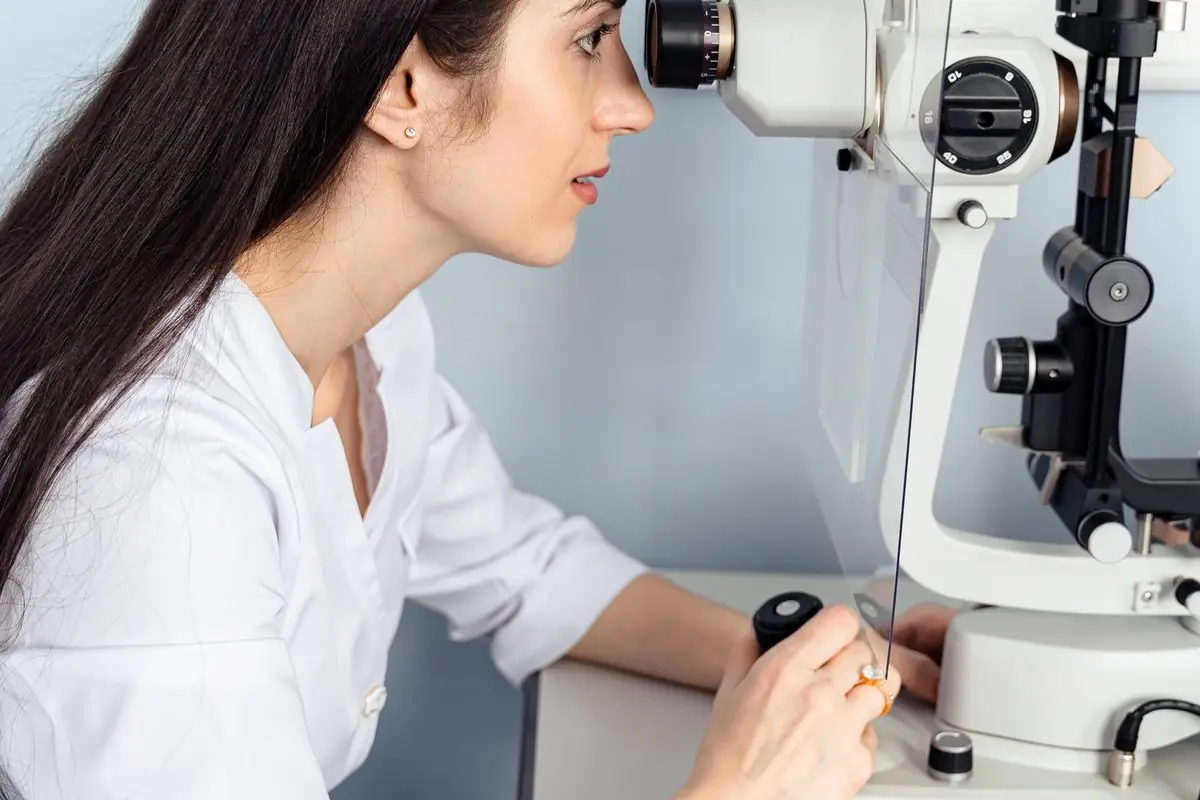
- The front of your eye. A microscope called a slit lamp shows the cornea, iris and lens, and picks up problems such as dry eye, cataracts and inflammation.
- The back of your eye. A bright light or a camera shows the retina, the macula and the optic nerve. Many practices offer a retinal photograph or an OCT scan, which gives a cross-section of the retina. OCT often costs extra.
- Eye pressure. A puff of air or a small probe measures the pressure inside the eye. High pressure is a risk factor for glaucoma.
- Your field of vision. You press a button when you see flashes of light at the edges of your view. This checks for gaps in your side vision.
- How your eyes work together. Simple cover tests check alignment and movement.
Drops which make your sight blurry
Sometimes the optometrist puts in drops to widen your pupils, so they can see more of the retina. The drops take about 20 minutes to work and leave your sight blurred and sensitive to light for a few hours. Do not drive until the effect has worn off. Take sunglasses.
What you get at the end
You get a written prescription if you need glasses. You can take this prescription to any opticians. The optometrist tells you when to come back. For most adults this is every two years. People with diabetes, glaucoma, a strong prescription or an eye condition under review are often seen every year, and children can be seen more often while their eyes are still growing.
If the optometrist finds something which needs a specialist, they refer you to a hospital eye service. For an urgent problem they can arrange a same-day appointment through the local urgent eye service.
Who gets a free test
In England the NHS pays for your sight test if you are under 16, aged 16 to 18 in full-time education, 60 or over, have diabetes or glaucoma, are 40 or over with a parent, brother, sister or child with glaucoma, are registered as sight impaired, or get certain benefits. In Scotland everyone who usually lives in the UK gets a free NHS eye examination. Wales and Northern Ireland have their own rules.
Check the rules in your nation
If you cannot get to an opticians
If you cannot leave home without help because of illness or disability, you can ask for a home sight test. Many opticians run a mobile service, and the NHS pays if you are eligible for a free test.
Sources
- NHS: opticians and eye tests
- NHS: free NHS eye tests and optical vouchers
- NHS inform: NHS community eyecare in Scotland
Checked 4 October 2026. Official pages change, so follow the NHS page for the current position.
Educational information, not medical advice. Not yet clinically reviewed. Your own eye-care team's advice comes first.